


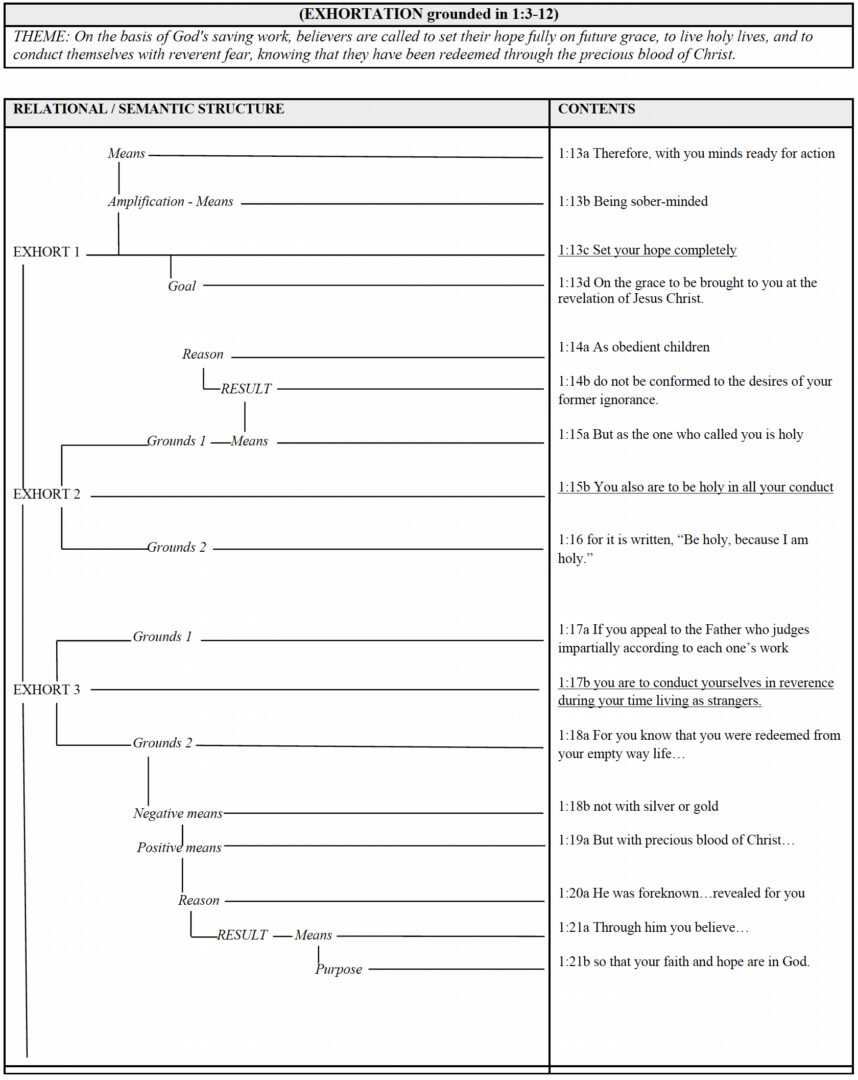
A SEMANTIC AND STRUCTURAL ANALYSIS (1 Peter 1:13-21)
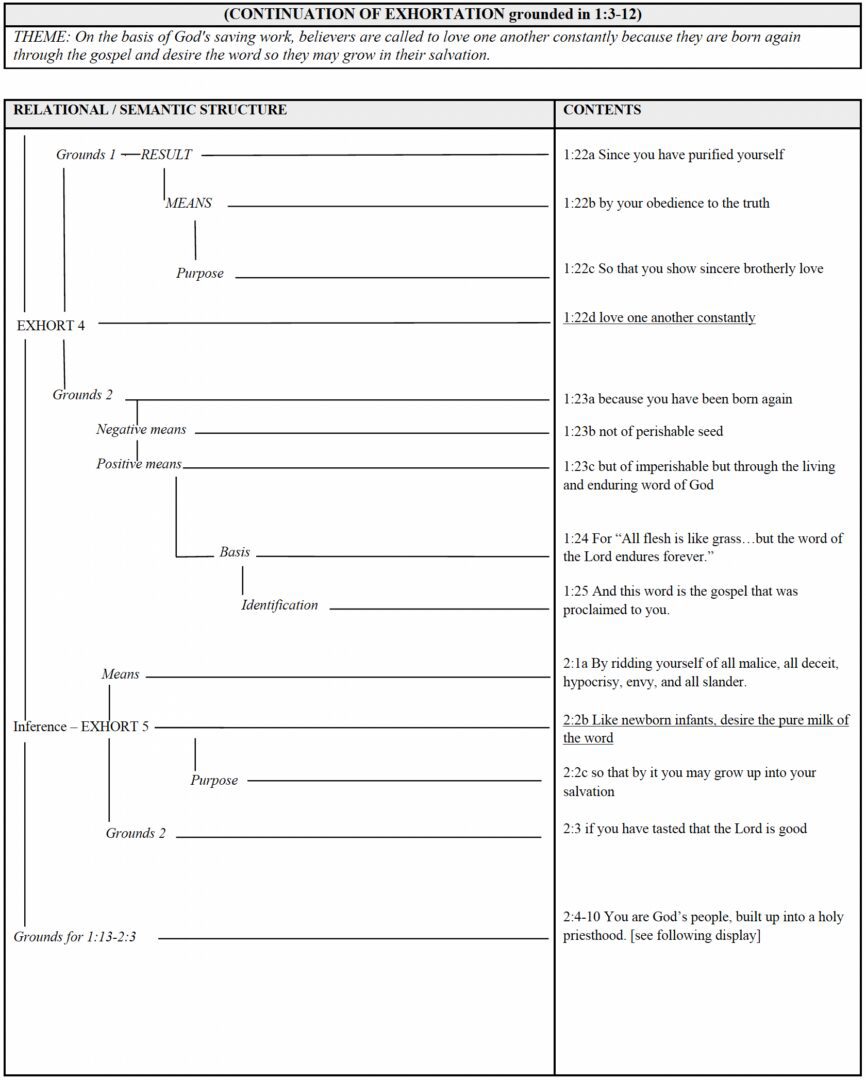
1 Peter 1:22-2:3
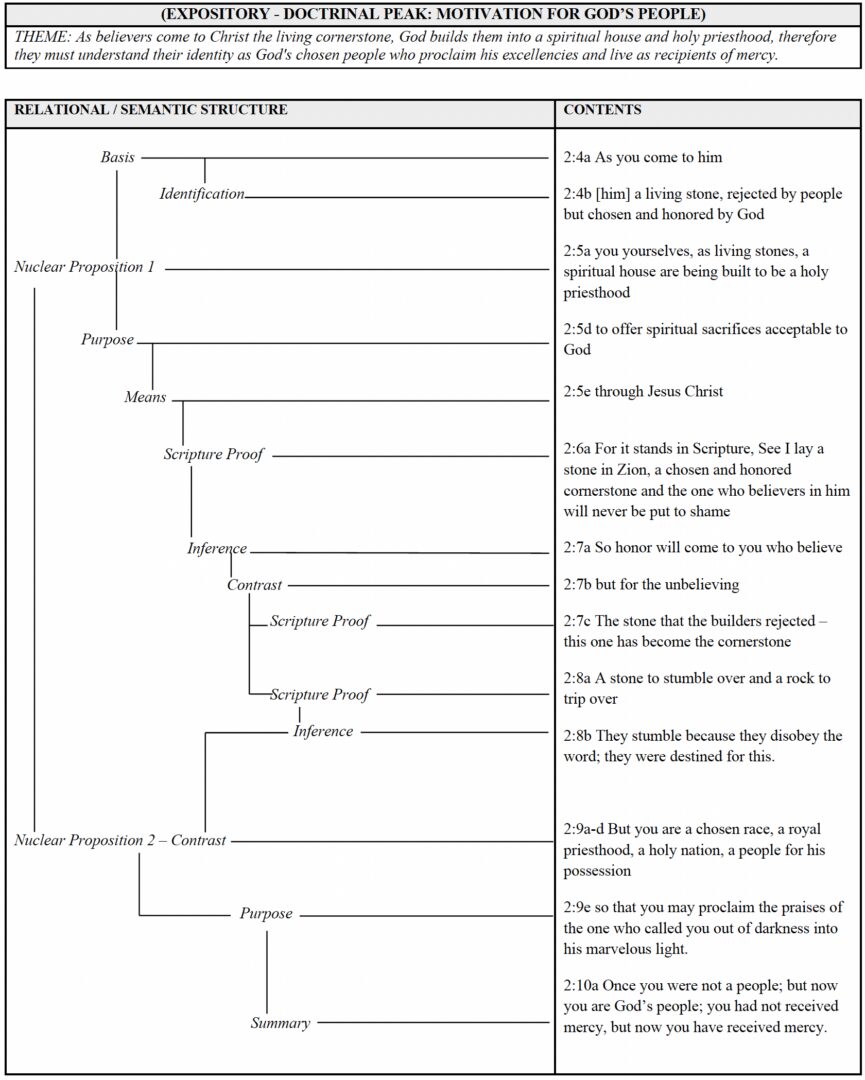
1 Peter 2:4-10
Sermon Outlines
1 Peter 1:13-2:3 “Living as Exiles”
Central Idea: Because we are Exiles, We are Called to Live a Sanctified Life as We Wait for the Coming of Jesus.
How do we live as exiles in this world?
- Redirect Your Hope [v. 13]
- How Do We Redirect Our Hope (Means)
- By Preparing Our Minds, Being Clear-Headed
- What is the Goal of Our Hope (Goal)
- The Coming Grace of Jesus
- How Do We Redirect Our Hope (Means)
- Live a Holy Life [v. 14-16]
- The Call to Holiness (Reason-Result)
- Because We are Obedient Children, We Must Not Be Conformed to Our Old Way of Life
- God’s Holiness Grounds Our Holiness (Grounds)
- Scriptural Proof: Leviticus 11:44-45; 19:2
- The Call to Holiness (Reason-Result)
- Conduct Yourself with Reverence [v. 17-21]
- We Should Live with Reverence Since the Father Judges Impartially (Grounds)
- We Should Live with Reverence Since We Have Been Redeemed (Grounds)
- Christ’s Death is Sufficient because it Was the Father’s Eternal Plan
- Because it Was the Father’s Plan, Salvation Through the Son Leads Us to the Father
- The Purpose is to Bring Us to Faith and Hope in God Alone
- Love One Another [v. 22-25]
- We Have Been Purified Through Obedience for the Purpose of Love (Reason-Purpose)
- We Can Love Each Other Since We Have Been Born Again (Grounds)
- Scriptural Proof: Isaiah 40:6-8
- Hunger for the Word [v. 2:1-3]
- Hunger for the Word by Putting Away the Sins of Your Former Life (Means)
- Hunger for the Word for the Goal of Spiritual Growth (Purpose)
- Hunger for the Word Since You Have Experienced God’s Goodness (Grounds)
Homiletical Suggestions for 1 Peter 1:13-2:3
- This text is hortatory. It is imperative driven. The surrounding clauses support the imperative. You’ll need to determine the functions of participles.
- Understand the theological motivation: eschatology shapes our ethics; God’s holiness motives our personal holiness; the Christ-event grounds our public witness; regeneration leads to love; union with God prompts hunger for the Word.
- You can preach the entire discourse as one sermon. Though it will limit the exegetical detail in the sermon, it provides you the ability to capture the flow of the text.
- You can preach each individual exhortation in one sermon, giving you 5 individual expository sermons.
- Be sensitive to the macro-structure of the text. 1:13-2:3 is grounded in the larger discourse unit of 1:3-12 and 2:4-10. Let these units flavor your exposition of 1:13-2:3.
- Delivery: state the exhortation first in your sermon and then show the relationships of the other clauses. The structure of the text is shaping the sermon. The “point” is the exhortation. Everything else modifies the exhortation.
1 Peter 2:4-10 “His Priestly and Prophetic People”
Central Idea: Since We have Placed Our Faith in Christ, We are His Holy People Who Serve Him Sacrificially and Proclaim Him Faithfully.
- We are His Priestly People Who Offer Spiritual Sacrifices to Him [v. 4-8]
- We Are His People Who Have Come to Christ by Faith (Basis)
- We Are Being Built into a Holy Priesthood to Offer Spiritual Sacrifices to Him (Purpose)
- Proof: Isaiah 28:16
- We Are Not Like Those Who Rejected Him (Contrast)
- Proof: Psalm 118:22 and Isaiah 8:14
- We are His Prophetic People Who Proclaim the Greatness of His Salvation [v. 9-10]
- As His People We Are (Identity):
- Chosen Race (DT 7:6; 10:15)
- Royal Priesthood (Ex 19:6)
- A Holy Nation (Ex 19:6)
- A People for His Possession (Isaiah 42:12)
- As His People We Proclaim His Praises (Purpose)
- As His People We are Recipients of His Mercy (Summary)
- As His People We Are (Identity):
Application:
- As a Church, We are His. He Knows us, Names us, Calls us. Everything We “Do” for Him is a Response to His Mercy. (Theological)
- Worship Fuels Mission. Proclamation is the Result of Worship. (Missional)
- How is Our Church Known in the Community? (Examination)
“We, as Christians, are the Chosen People of God; we are the exiles of eternity. Therein lie both our priceless privilege and our inescapable responsibility.” – William Barclay
Homiletical Suggestions
- Remember that this is the first doctrinal peak of the letter. Semantically this carries significant weight, as Peter is concerned about the identity of God’s people. This text seeks to motivate the Church in understanding what God has called them to in this world.
- Peter mixes OT metaphors: Temple, Priestly, Nation/State. These are the most prominent aspects of the text. Thus, this needs to be communicated in the sermon. You need to flesh out the priesthood, spiritual sacrifices, and prophetic concepts.
- You could preach 2:4-8 as one sermon and 2:9-10 as a sermon. But it is important to maintain continuity between the sermons.
- Aim for congregational application, less “personal” application. Instead of “you” focus on the “we.” What does it look like for a congregation to take this text seriously?
- Don’t get bogged down by over-theologizing the text, specifically 2:8b (this is an inference). Keep it simple – Those who believe in Jesus are honored, those who reject Him disobey. The prominence of the text is the identity
of God’s people.