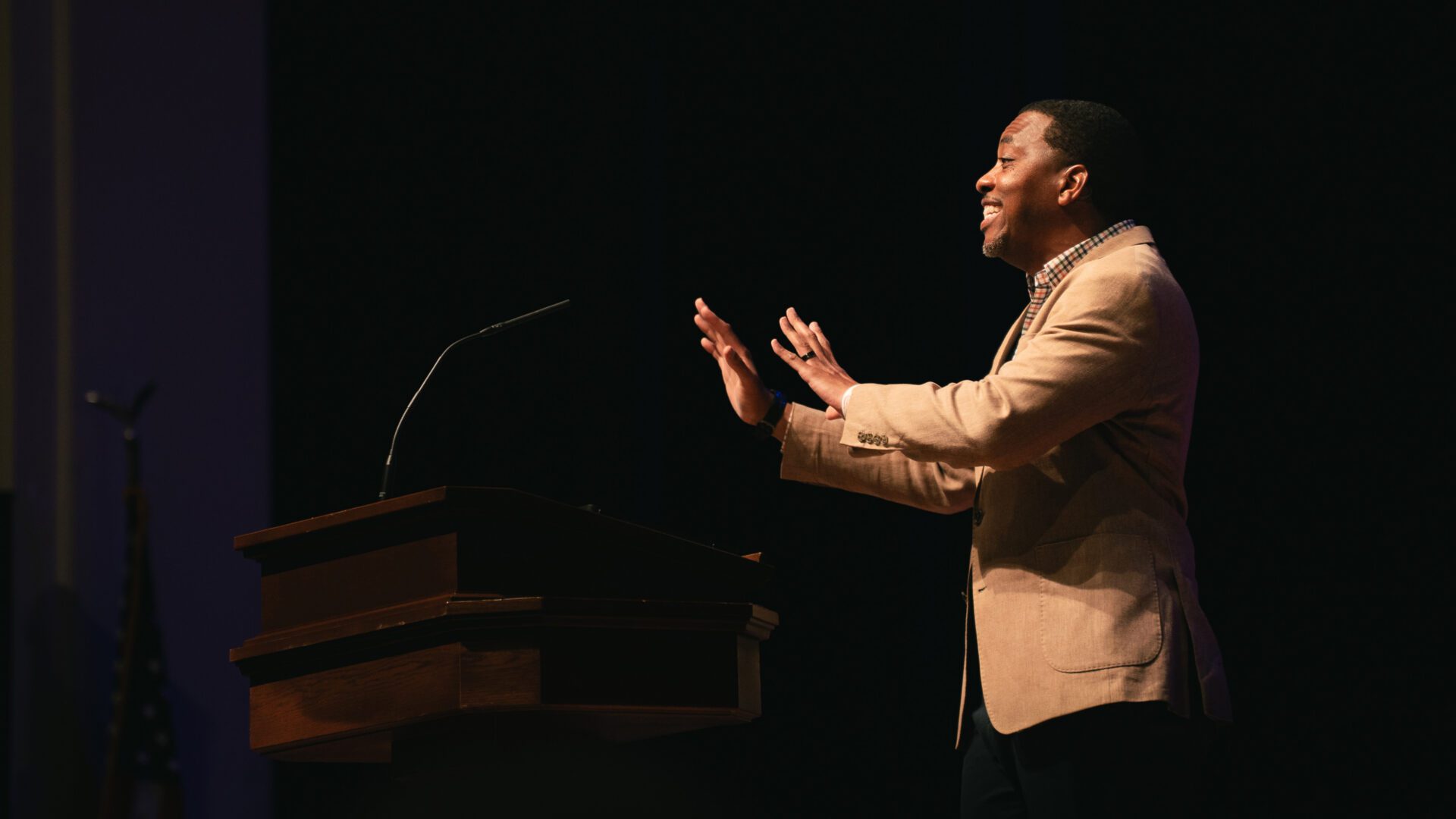
The following is an uncorrected transcript generated by a transcription service. Before quoting in print, please check the corresponding audio for accuracy.
It’s a good day to be here. I am thankful to be able to bring God’s word to you, and thankful that you are here, Dr. Dockery. I want to thank you for your kind words and what you and your wife mean to the Bradford family. So thank you for giving me this opportunity to be able to preach God’s word. Thank you for friends that are here, new friends and old friends and classmates and just and students. And so looking forward to what God is going to say to us today. If you have a copy of God’s word, would ask that you would turn back to Micah chapter six. Micah chapter Six. Dr. Doctor read for you verse eight. We’ll just read that one more time and pray, and then get started. Micah chapter six, verse eight. He has told you, O man, what is good, and what does the Lord require of you? But to do justice, to love kindness, and to walk humbly with your God. Let us pray. Our Father and our God, we thank you. We praise you today for this opportunity that we have in the land of the free, to come and hear your word, free of persecution, we pray that you will speak to us from your word today, from what you have already written down long ago. We pray that in everything that you would be the focus of this service, that you would be glorified, that you would be exalted among measure. Father, we love you and we thank you in Jesus’ name. We pray, Amen. From this passage of scripture today, I want to speak to you from the subject: the faithfulness of God. The faithfulness of God. A couple of months ago, I came across a show one day. It was a television show about a courtroom. It’s not the one that you would think that you usually would see. It was not about a small claims court, about a particular fence that went up between neighbors in a dispute, or either an unpaid loan. Rather, it was about two judges, a man and a woman, a team, a husband and a wife, that were previously lawyers, and what they would do is they would preside over relationship issues, relationship and couples. They would give verdicts towards relationships, towards marriages in a crisis, families that are on the edge, and after looking at this show for some while, I begin to notice how they were trying to answer this question: Do you have what it takes to reconcile, or is it time to call quit. As I continued to watch the show, there was another question that began to form in my mind, and this was the question: How bad does it have to get between a husband and a wife? How bad does it have to get between two parties that are in a relationship that it would cause one party to drag another party into litigation, into the court. You think about it. Nobody wakes up on an ordinary morning and decide that they’re going to air their dirty laundry in the courtroom or on TV. There’s no husband, there’s no wife that is saying, “Listen, because you missed the anniversary, because you left some dishes in the sink, I’m going to bring you into court.” If that was the case, I would be in court over and over again. But people end up in court because there’s something that is broken deeply and has been broken for so long, and they seem to get to a point where they can’t fix it. As I kept watching the show, I begin to realize that the answer to that question of why would they go to court wasn’t because of one mistake. It was because over and over, little by little, one of the parties began to break promises over and over. They didn’t keep today marriage vows to love you to death, to honor and to forsake all others, one person here just walked away from the union, and in one word, it was unfaithfulness. My brothers and sisters, that same thing can be true when we look at the people of God and God, so often when we look at the people of God and the union between God, we see that there is unfaithfulness going on. This is the scene.
This is the context of the book of Micah. God is in union with his people, but his people have not kept their covenant. Little by little, breaking promise by promise, they have come to a place of litigation, and we’re asking the question: Can this be fixed? The Lord God sends Micah to give three oracles in the book of Micah to discuss the unfaithfulness of his people. In chapter one, verse two, he gives an oracle. In chapter three, verse one and following, he gives an oracle. And by the time you get to chapter six, you are meant to understand and ask that question: Can this thing really be repaired, or is it time to break up? And it’s today that we have the privilege of looking at chapter six, that third oracle, in a way that is the scene of a courtroom, a trial, if you will. And so, as we sit by today and we sit back in the gallery, we’re going to look at a scene. We’re going to look at a trial of the Lord God versus the people of Israel. Right up front, I want to let you know that as we move through this courtroom scene, we’re going to see four stages, four scenes. Number one, in verses one through two, we’re going to see that the Lord has a case against His people. In verses three through five, we’re going to see that the Lord has a commitment to His people. In verses six through seven, yeah, I said six, seven. The people have a counter offer for the Lord, and then in verse eight, we’re going to see that the Lord has a command for His people. Go with me to the text and notice that first stage, that first scene as we approach the courtroom. The Lord has a case against His people. Micah here is serving as the Lord’s prosecuting attorney. The Lord is serving as the plaintiff and the judge, and the Lord is sending Micah to call the people of Israel to court. Notice what the word says. It says, “Here, get ready.” He tells Micah, “Now hear what the Lord is saying. Get ready to plead your case before the mountains.” You will notice three times in the next two verses, in verse one and verse two, you see this plead your case. You see this the Lord has an indictment. You would see that He has a case against His people, using this Hebrew word here with this idea theologically thinking about a covenant lawsuit. Micah is stressing the idea that he has strife with his people, that he has a dispute with his people. Micah is stressing the idea that he has smoke with his people. But here’s the question: What could be so bad that it would cause the Lord God to drag his people in to the courtroom? Well, I’m glad you asked. In the book of Micah, we see in chapter one and in chapter six and other chapters that the people are guilty of idol worship. They have become guilty of idol worship and practices of idolatry. Those that are wealthy, they are converting and seizing the people’s land, and if that’s not bad enough, they’re looking at the poor babies and they’re taking their inheritance. Those that are supposed to be judges and rulers, those who are supposed to keep the law, the Bible says that they hate good and that they love evil. They’re perverting justice. The things that are called bad, they’re saying that they are good. The things that are good, they’re saying that they are bad. And then, as we move further along, even the priests and the prophets, they teach for a price. The prophets, they tell fortunes for money. In other words, they are willing to sell God’s word out for little change. This is the scene. This is the depravity and what’s going on in the society. But notice what Micah says, and the Lord tells him. He says, “Listen, you mountains, to the indictment of the Lord, present your case before the mountains. He’s calling him to be the mountains to be a witness, the heavens and the earth to be a witness against the people. Why? Because they are the enduring foundations of the world. But not only that, the Lord knew that the people will suffer from spiritual amnesia at some point.
So long ago, he had the mountains, he had the earth to take notice of the covenant that was made. We see an example of this in Isaiah chapter one verse two. But the example I really like, and I think really paints a picture, is in Deuteronomy chapter 31 and chapter 32. The Lord God tells Moses, “He said before you die, make a song for the people.” And he says, “Listen, the people when they go into the land, they are going to forget about me. But this is going to be for a reminder of the covenant that they broke.” In verse 27, I really like how Moses getting out and saying it. Moses says, “Listen, you people have been rebellious all the time while I was living, and you see, and and you see different when I die. So now I’m writing a song that you will know that the Lord God is faithful. That’s the scene that we have going on here. But did you notice? Arise, plead your case to the mountains. Let the hills hear your voice. Listen to the mountains, to the indictment of the Lord, an enduring foundation, because the Lord has a case against His people. Even with Israel, He will dispute. It’s interesting to note here that the Lord already knew that they were going to be unfaithful. Nothing got past the Lord. The Lord already knew that they were going to drift. The Lord already knew that when they experienced the good life, they were going to leave away from a great God. The Lord already knew that. And my brothers and sisters, I can’t help but to think today that if God is not surprised about the people of Israel’s sin, that He is not surprised about the sins of the world. Many times people say, “If only these walls could talk.” Right? Well, if these walls could talk, if these mountains could talk today, what would they say about the people today? Every lie, every bribery, every back corner meeting, every gossip, everything would be exposed. The Lord here says, at the end of verse two. Even with Israel, He will dispute. Here you see that the Lord has an argument. He wants to reprove them. He has to decide this matter, this lawsuit now is not going to stay at the level of accusation, but it’s going to move to a place or ruling. The Lord indeed had a case against His people because they were being unfaithful. Notice the second stage: the Lord has a commitment towards His people. Notice in verse three, my people. Stop right there, my people. He’s also mentioned this earlier in verse two. His people, even in the midst of this relationship, not so straight and is rocky, it seems like it’s going to end. He is still referring to them as his people, they’re not strangers. They are his people. God is asking his people here, what charge can be lodged against me? Notice what the people says, my people. What have I done to you, and how have I wearied you? At some level, like in most relationships, when somebody does wrong, you begin to blame the other person. My wife often tells me, she said, “I know if I tell you this, you’re gonna begin to blame.” She said, “Oh, here, there you go, right?” So now I’m preaching out of my own life. But when a person is wrong, they’re trying to find a reason why they can have a justification, why they can have an excuse. So the Lord calls back their memory. He knows that they’re going to have spiritual amnesia, and so He calls back their memory and He talks about His commitment that He has before them. In other words, God came to court with all the receipts. Notice what he says in verse four. Verse three says, “Answer me.” There is no answer in verse four. He says, “Indeed, I brought you out from the land.” The Lord here is showing that He has provision. He’s going to show that He has protection. He’s going to show that He had a purpose for them, but He also pardoned them. He says, “I brought you out of the land.” And he’s asking the question right after this: How have I wearyed you? Have I wearyed you by bringing you out of the land?
You’re saying that I weary you, I pressed you down, I’ve exasperated you, I’ve exhausted you, but rather I have brought you up. He also says, “Listen, notice I’ve brought you up out of the land of Egypt, and I ransomed you from the house of slavery. He said, “You forgot that you were in slavery, and I ransomed you from Pharaoh. I got you to come out. I put the pledge on Pharaoh. I provided the sacrifice, the blood on the doorpost. I allowed you to go free. And even when Pharaoh chased you, I was there to bring the waters back upon them. Do you remember? Has that worried you? He goes on to say, Micah, and I sent before you Moses, Aaron, and Miriam. After I brought you out the land of captivity out of oppression, I gave you leaders that can lead you. I gave you a mediator that can talk to me. I gave you a prophet and a priest in Aaron. I gave you a prophetess. I gave you a poet in the person of Miriam. I gave you leaders that you can trust in. I gave you provision, but I also gave you protection. Notice he says in verse five, “My people, remember now what Balak, king of Moab, counsel what Balaam son of Beor, answered him.” If you remember that story over back in Numbers chapter 22, Balak goes and petitions for Balaam to a curse on the people of Israel, and the Lord God said, “No, don’t listen here. Don’t answer him. Do not bring a curse among the people, but then they kept coming, and then eventually he tells him that he can go, but he tells him to only do what I have said. And it seems somewhere in the text, and our Hebrew professors can can clear this up for you. It seems somewhere during the text that he he appears like he is actually going to might give in if the money is right, and God puts up a stone wall so much that even His beasts cannot get through. The Lord has protected them, and they were not even aware of the protection. Has that wearied them? Notice, and He says protection, but then also a purpose and a pardon, and from Sitim to Gilgal. What about that? He says, “You remember that I brought you to the last place before you crossed the Jordan River. Then I brought you to the first place of bringing out the joy of the river. When you begin to sin, I took you from there. I made a promise to you, and I kept the promise. But also, I pardon you all along the way because it was along the way that you begin to commit sexual immorality. You begin to commit idolatry. I pardon you along the way. Have you forgotten? And notice the purpose in all of this, so that you might know the righteous acts of the Lord, that you may know that the Lord is just, that He does what is right, that He is working on our behalf. Israel begin to forget. They begin to think like you know. I haven’t been away. I’ve been away from Egypt quite a long time now. I don’t know if the chains were actually that type. They begin to think about going over the Jordan River, and they begin to say things like, “I don’t know. Maybe it was us who brought us over.” They begin to forget about the goodness of God. They they begin to get how God provided for them, how God protected them, and how God pardoned them. Maybe it wasn’t these leaders that you gave us, we were going to do this anyway. This is a sobering reminder to God’s people everywhere that the Lord God has been faithful in our life. Even though they’re on trial, we can clearly see that the Lord has been good. Probably every believer that you poll will give you some type of testimony, and say, “I was in a situation that I put myself in, and the Lord got me out of it. There was a relationship I put myself in, and should never have been in, but the Lord got me out of it. Truth be told, there I probably should not even be standing here today. I shouldn’t be holding this position. I shouldn’t be preaching in chapel.
But the Lord got me out of it. We all have that type of testimony. That’s why I like when the Bible says in First Chronicles chapter 16, verse 34, “Oh, give thanks unto the Lord, for He is good, and His mercy endures forever.” These people begin to forget about the commitment that the Lord had for them. Well, in the third stage, notice the people have a counter offer for the Lord. God has asked them twice to answer me; they have not answered. They say now we have to say something, and so they’re to the point that they’re ready to answer, but they’re going to get a give a counter offer to the Lord. Notice in verse six, he says Micah speaks on behalf of them, and in verse six he says, “With which shall I come to the Lord and bow myself before the God on high, the God that is high in His temple?” They’re acknowledging. that God is out of their reach, that God is holy, that God is righteous, and notice what they begin to say. The offer they begin to make, they said, “Listen, shall I come to Him with burnt offerings, with yearly calves, both sacrifices that we see in the book of Leviticus and others, but notice both of them are plural. The yearling calves, the calf could be sacrificed after eight days, but they would take care for a whole year without spot, without blemish, and give it to them. They say this has, in other words, this has cost us something, and we’re giving you a lot of it. We know what the problem is. You’re upset, and we want to give you something to suppress your anger. They go on to say, “Does the Lord take delight in 1000s of rams and 10,000 rivers of oil? Shall I present my firstborn, my rebellious acts? Did you notice that? This is the problem that they have, and they don’t realize they’re walking and and demonstrating they still have this very problem. They misunderstand the character and the faithfulness of God. They say we know what the problem is. The problem is that you’re upset, and so therefore we will give you more. Remember the complaint that was made earlier. They he wearied us, and so they’re still thinking God is that type of God, and so therefore he’s pressing down us more, and he just wants more, and so therefore we will give you more, and it appears that these people get to a point that they are so depraved, that they are so anxious and so desperate that they’re even willing to sacrifice their own kids, acting after the way people did and sacrificed to the God of Molech, things that God had already told them that was detestable. They’re basically asking God, “What more do you want?” Each step raises the price. Do we notice that the whole thing assumes that the relationship between God is a ledger that can be balanced rather than a God that can be trusted? That’s the issue here. We can pay you off, but isn’t that the question of man of all kind, of all time? Man always wants to know God. What is it that you offer? What can I give to get back in your favor? Here, I imagine that courtroom scene, and I imagine a person standing before the judge, and they’re starting to realize that they are guilty, much like the people of Israel. And can you imagine a person walking up to the judge and saying, “Listen, I want to make a donation to the court, they pull out a bill fold and they pull back some ones, and they’re looking at the judge, and the judge doesn’t answer. And they said, “Yeah, I want to make a donation to the court,” and they start to peel off some hundreds, and the judge is still not answering. They go in, they pay off another 100. They got a couple of 1000s, and the judge still does not answer. This is the problem. They’re raising the stakes, and they’re thinking they can buy God off. And there’s no difference in people today. God, if you get me out of this, I’ll do this. I need to start giving more in my time. I promise you, I will go and serve here if I can only be let off the hook for this.
And it’s clear here that the Lord has already told him what he wants. And then we get to verse eight, where we see that the Lord has a command for His people. The word of the Lord says, “He has told you, O man, what is good? What does the Lord require of you but to do justice, to love kindness, and to walk humbly with your Lord? The first thing you notice here, the Lord says, I have already told you. The Lord does not remove His stand. I remember a long time ago. A good illustration of this may be there was a professor here that I had. It was a Hebrew professor, and he’s not here anymore, right? Hebrew professor, and the Hebrew professor would come in and give us a test. He would give us a test: five sentences, five words each, each word, parse, give the definition, break them up in Syllables. If you messed up on one part, the person definition, the the syllables of one word, the whole sentence was wrong. That professor was saying, “Listen, I want perfection.” And I remember people saying, “Man, this is not right. He should be giving this type of test to Dr. Williams, Dr. Dodd, or somebody else. He’s giving it to us. We’re trying to learn this.” But there was a lesson even in that. He wasn’t willing to go down on his standard, and when we look at the Lord God, how should we feel any different about the Creator and the Holy God of this universe? He says, “I’ve already told you what it is. I’ve already given you the commandments. What is good? What does the Lord require? But to do justice. Don’t just talk about justice as people say. But to do justice. Justice is not what you’re doing as you’re out in this neighborhood and taking people money. You’re out. You’re out here and you’re doing idolatry. You’re robbing people. You’re stealing people. You are taking advantage of the poor. That is not justice. Justice is fulfilling an ethical response towards God that often benefits others. You’re serving. You’re doing these things number one because they’re good. God has determined they’re good, and you’re pleasing Him. And out of pleasing Him, the society also gets help. God says, “You are to do justice.” Really, He’s saying, “Listen, you are to have true religion.” James chapter one verse 27 says, “Like this, pure and undefiled religion in the sight of our God and Father is this: to visit the orphan and the widow in their distress, and to keep yourself unstained from the world. Do justice. Don’t just talk about it. Be actively involved. You know when there’s something right, do it. And I think this meets the role when you are in a group, in your classes around places you see things that are not right. Number one, you’re doing these things to honor God, but also you’re doing it for the good of people. Problem with people is they’re hypocritical in their justice. I’ll show justice for this because this is what I like, but over here I don’t care. He says to do justice and to love mercy to be have this faithful covenant love, this same love that I’ve demonstrated before you. You are to have if we are to do justice into love, mercy ought to be the motivation. We ought to love to do good and mercy and show loving kindness to others. You ever meet people like they just they’re not happy until you are not happy, right? Problem. Sometimes people say it like it’s a good thing. I want to go in ministry. I want to do this, but I just don’t like people. And I just leave that scratch in my head. You leave that scratch in head, trying to figure this out. The person’s really hard. They’re dictative. They come down Phariseeical on people. They have no mercy for a person, but then every time something happens with them, they want it to be excused. Lord God said, “You are to do justice, love kindness, and to walk humbly with your God.” You have to have a right posture as you walk with God, you have have a right mindset to know that He is God and that you are not. Right, that He is faithful and that you are not. This is what He is telling them.
He’s already told them these verses have kind of served as a model for religion. They’re written on the rim of the congressional library in Washington. A lot of the politicians will quote these. A lot of church people will use this as a preaching theme. But as one person said, I only wish people would do it more and stop talking about it less. This ethical requirement that God has called these people to in this courtroom scene, it is clear why why they are there. The people of God have not learned their lesson. They have been unfaithful to God. As the courtroom scene continues to go on in the rest of chapter six, you’ll see that God continues to pronounce this thing after thing that they have done and how they have been unfaithful. And even when you look at verse eight, don’t miss this and don’t misunderstand that this is not stating that if you do this, you can earn favor with God. Rather, you should already be doing this because God already has a relationship with you. That was the problem. They wanted to do more things, but rather they didn’t want to bring their heart. God says, “I want you along with the praises and the worship that you give me.” These things are not bad within themselves. It was the fact they were willing to give them these things and not give of themselves. And when you begin to look at this society in Micah, you begin to look and see and ask yourself: Is there any way that this thing can be fixed? And so, the prophet Micah, in chapter seven, he stops looking around at the society and being dismayed, and he starts to look up towards God. Notice in chapter seven, if you flip over, in verse 18, we can just go there quickly. He says, “Who is a God like you?” These play on words, Micah names. Who is like God? Who pardons iniquity, passes over the rebellious acts of the remnant of his possession? He does not retain his anger forever because he delights in the unchanging love. Micah said, “Listen, there is hope. The society is going rapid, but there is hope. People are stealing from people, but there is hope. My hope is in the Lord. And listen, today we have that same hope. Up until now, we’ve been talking about this this courtroom scene, and we’ve been sitting in the gallery and looking at the the judge, Lord God, the plaintiff, and the judge. And over here, we’ve been looking at Israel, who’s on trial, and we’ve been looking at Micah as the prosecutor. But just for a moment, what if God called us from the gallery to sit in the seat of Israel? What would the mountains, the walls, other people say about us? How would we respond to our God? Would we search for more things to give Him to try to appease Him? The Bible is letting us know here today that man cannot do enough to please God. That when man is unfaithful, God is still faithful. So I want to tell you today, my brothers and sisters, as you look around and you look at the situation, the world, and you begin scratching your head and say, “This is terrible.” As you begin to look at the situation of those in leadership, and you begin to scratch your head and say, “This is terrible. They’re not doing what they’re supposed to do.” Even as you look around, you begin to look at people in the church, and you’re saying they’re not doing what they’re supposed to do. And also, when you look at yourself, and you see what you’re not supposed to do. You could be confident that the Lord God is faithful. He will pardon your iniquities, and ultimately, He does that in the person of Jesus Christ. I am so glad that God sent Jesus to die on the cross for our sins. That He was faithful where we cannot be faithful.
As we’re sitting in that courtroom today, and the gavel is getting ready to come down on Israel. It’s getting ready. Church is getting ready to come down on the whole entire world. I get a glimpse of hope because I see the doors open, and I see Jesus Christ walk through the door. I see him coming through the door, and he’s standing and he’s objecting about what is being said because he is putting himself on the altar for us. He’s willing to take our place. He’s willing to.
That lets me know from this passage in Micah and throughout the whole Bible that God is faithful. I’m so glad that He is faithful today. God, would you today as we come to this text and we leave this place? Would you bring to our minds, not to point the finger at it, not to think that we’re better than they are, but ultimately, Father, to look at our situation, their situation, the world situation, and to look to the one who is faithful, and that is Jesus Christ. Thank you, God, for your faithfulness, for your character, and what you have done. And it’s this, Father. This is where our hope lies, and nothing else but other than your finished work, Calvary Club. God, we love you, and we thank you. In Jesus’ name, we pray. Amen. Will you stand? Let’s sing in response to God’s word about our faithful God.